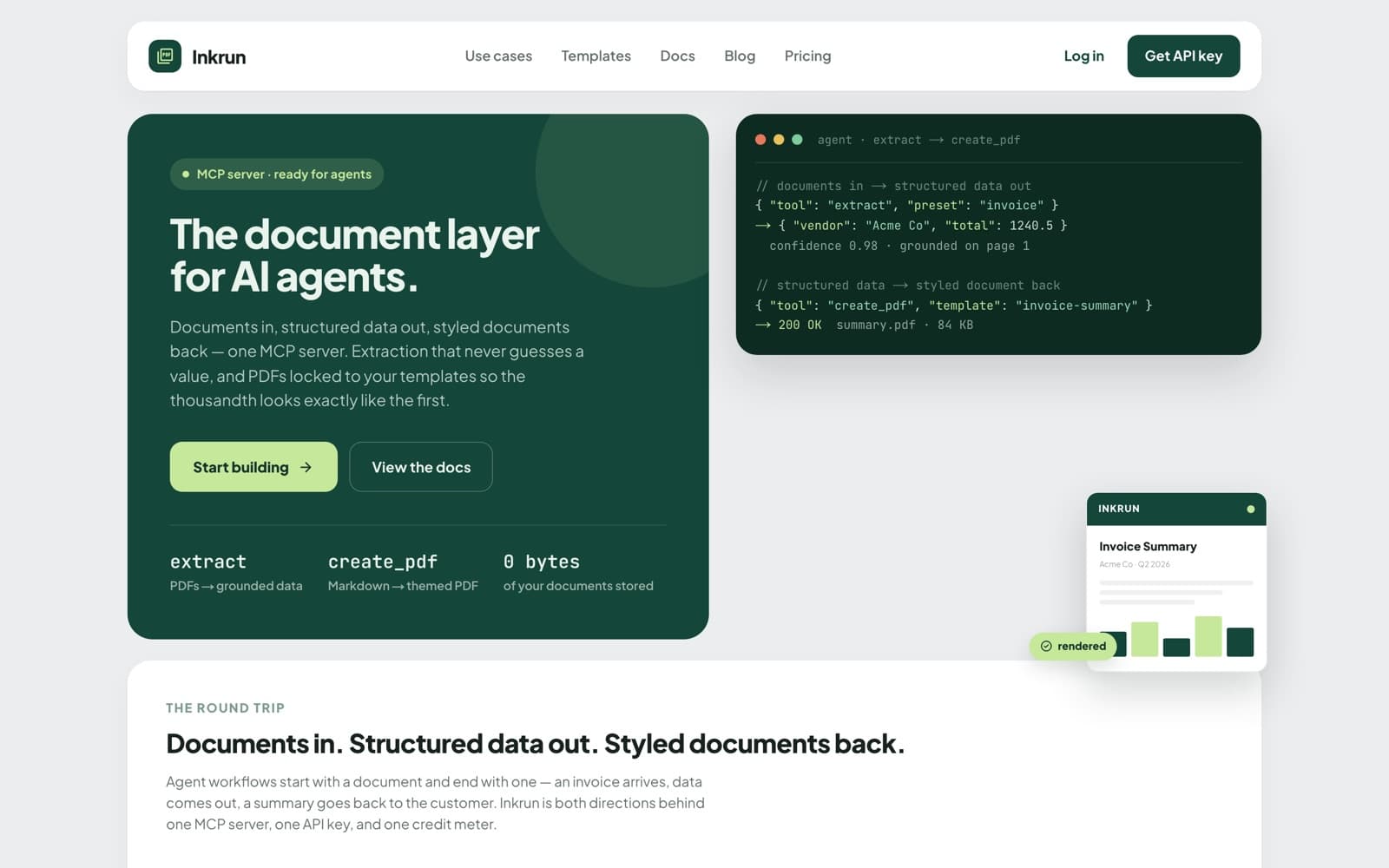
Inkrun is a document platform built for AI agents. An agent — in Claude, in ChatGPT or in an automated pipeline — receives a PDF, pulls the data out in a structured form and sends back a new document that looks like the brand of whoever is using it. Supplier invoices, contracts, official forms, reports: documents in, structured data out, styled documents back.
Cottonhat built the entire MVP from scratch: from product and architecture to the website, the documentation, the paid plans and the launch. The platform was delivered in production and fully working, with customers able to sign up and use the API from day one.
The challenge
- A new category. AI agents need to read and produce documents, but existing tools were built for people, not for automated calls.
- Extraction that never makes things up. A language model returns plausible values; an accounts-payable process needs values that are actually in the document.
- PDFs that always look the same. Asking a model to write HTML gives you a different document every time. The thousandth PDF has to come out exactly like the first.
- Privacy for sensitive documents — invoices, contracts and personal data can't be stored or used to train models.
- A complete product, not a demo: accounts, API keys, rate limits, paid plans and documentation, ready for real customers.
What we did
Data extraction grounded in the document
The extraction engine reads a PDF and returns its data in a structured format — from ready-made presets (invoice, receipt, contract terms, tables, full text) or a JSON Schema defined by the customer. Every field comes with a confidence score and the page it came from, so no value is a guess. There are three extraction tiers — deterministic, model-based and OCR for scanned documents — plus a free inspection that tells you, before any credits are spent, how many pages a document has, whether it is digital or scanned and what it will cost.
Markdown-to-PDF generation, always on brand
The agent writes Markdown; Inkrun applies a theme and a template and returns a PDF. Templates lock down typography, colors, logo and footer, and rendering is deterministic: the same content always produces the same document, with embedded fonts and no external dependencies. We built a template gallery — quarterly reports, sales proposals, investor updates, technical manuals, case studies — and dedicated blocks for invoices, quotes and receipts, with totals calculated automatically.
MCP server and REST API
The platform has two ways in. The MCP server connects directly to Claude Desktop and claude.ai over OAuth, with no keys to copy, and to other clients such as Claude Code or ChatGPT. The REST API serves teams integrating from their own code. Both share the same tools — extract, inspect, extract tables, fill PDF forms, generate PDFs, and combine extraction and generation in a single call — and the same credit meter.
A complete SaaS around the engine
- Accounts and authentication, with email or GitHub sign-up and API key management.
- Dashboard with a template and theme editor and render history.
- Plans and credits — Free, Pro, Team and Enterprise — with per-key limits applied automatically.
- PDF delivery by email, with time-limited download links.
- Product website, use cases, blog and documentation, with a quickstart, an API reference and setup guides for each MCP client.
Privacy from the first line of code
Documents are processed in memory, never written to disk and never used to train models. The deterministic tier runs entirely on Inkrun's own servers; when a customer chooses the model tier, only the extracted text and layout are sent, never the original file. The data-handling policy is published in the documentation, in plain language.
The result
Inkrun 1.0 launched on July 1, 2026 and kept growing over the following weeks: full documentation and a template gallery, render history and email delivery, the extraction API with a unified credit meter and, in August, blocks for invoices, quotes and receipts. All of it on the same foundation built for the MVP, with no rewrites.
One of the published use cases shows the impact: a bookkeeping firm that receives thousands of invoices a month in different formats can now reissue each one on its own letterhead in seconds rather than minutes, without retyping the data by hand.