
02 / 04
CloseEscAPI2026
Inkrun
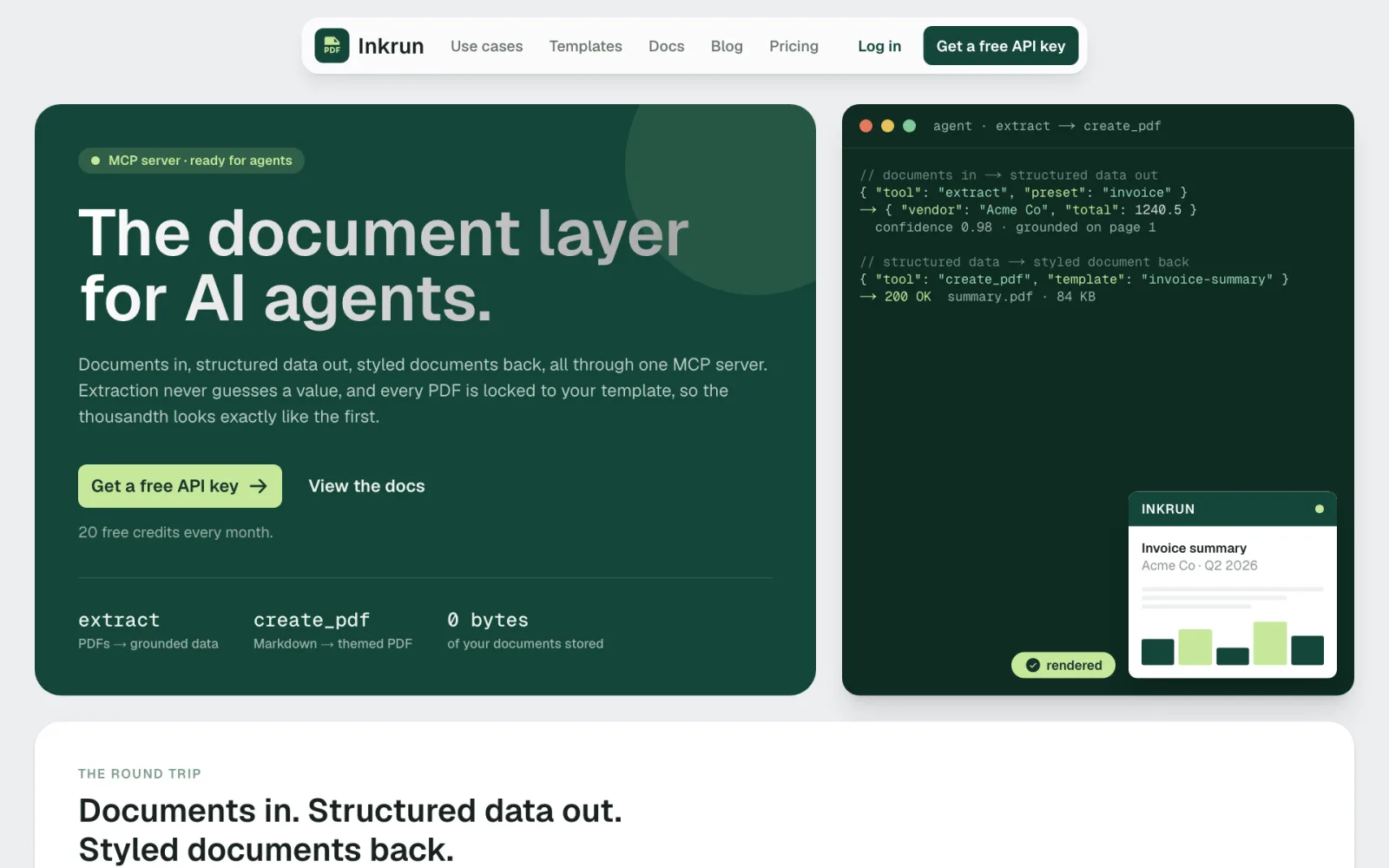
Our document API for AI agents: Markdown in and a branded PDF out, and PDFs back into structured data that never makes up a value.
- Type
- Our own product
- Scope
- API, MCP server, dashboard
- Launch
- Version 1.0 in July 2026
Keeping a document's content separate from its design
Language models write well, but when they are also asked to format a document in HTML, every result comes out slightly different, and any code they were given can end up on the final page. Inkrun solves this by splitting the two: the AI agent writes the content in Markdown, and the document's look comes from a fixed template.
Templates only accept hex colours and a closed list of fonts, with no free-form CSS. That guarantees every document generated from the same template looks exactly the same.
Consistent, predictable PDF generation
PDFs are generated by a limited pool of Chromium processes on the server. Fonts are embedded in the file, styles are included directly in the page, and nothing is downloaded from the internet during generation. As a result, the same request always produces the same PDF.
The Markdown also supports charts, written as a small table of data and drawn as SVG, and dedicated blocks for invoices and quotes that calculate totals automatically instead of leaving the arithmetic to the AI model.
Extracting data from PDFs
Two weeks after launch, Inkrun also started reading documents. It takes a PDF, such as a supplier invoice, and returns the data in a structured format. Every extracted value comes with a confidence score and the page where it was found.
When a value isn't in the document, Inkrun returns an empty field and a warning instead of inventing a plausible value. Documents are processed in memory and are not stored on the servers.
Access through an MCP server and a REST API
Inkrun can be used from assistants like Claude, through an MCP server, or from any application, through a REST API. Both share the same key and the same credits. Claude connects through OAuth, with no key to copy; other clients use an API key.
Version 1.0 was released on 1 July 2026, and four more releases followed in the next five weeks.